Dedicated Development Team vs Agency vs In-house: Which Fits Best?

Updated: Feb 12
Choosing a dedicated development team versus a software development agency or an in-house development team is one of those decisions that quietly determines everything that follows: speed, quality, cost, and how much control you actually have once the project gets real.
This guide is a practical decision tool. You’ll get a clear side-by-side comparison of the dedicated team model, agency delivery, and in-house hiring, and the cost drivers that typically don’t show up in the first quote. We’ll also cover red flags to watch for when evaluating any external partner (agency or dedicated team) and why certain setups become expensive through rework, slow ramp-up, or lack of ownership, especially when custom software needs to support real business processes and evolve through continuous development.
Finally, you’ll get a simple framework you can use to choose the right software development engagement model based on your goals. If you’re also considering team augmentation or staff augmentation vs dedicated team, we’ll clarify the difference so you don’t accidentally pick a model that creates more coordination work than it saves.

Quick summary
At a glance: which model is best for which situation?
If your work is product-like with continuous roadmap, iterations, long-term maintenance, a dedicated setup usually wins on continuity and ownership, particularly for custom software development that requires a reliable development process and strong project management. If your scope is truly fixed, a project-based agency can be efficient for a single software project. If software is your strategic core and you can invest in leadership, hiring and building an in-house team can pay off. However, you will need to estimate ramp-up time and hidden costs of in-house software development, including the cost of shipping and maintaining new software across environments and operating systems.
The biggest mistake we see is selecting based on a single dimension, which is usually price. The better approach is to decide what you’re optimizing for: speed, predictability, control, or flexibility. Use the table below as your first filter, then go deeper into definitions and cost drivers.
Model | Best for | Not ideal for | Time-to-market (ramp-up) | Cost predictability | Control & IP ownership | Flexibility to scale | Long-term maintainability |
Dedicated development team | Long-term product development, evolving roadmap, continuity, scaling delivery without full hiring burden | Very small one-off tasks with minimal management overhead | Fast–Medium (days to a few weeks depending on onboarding) | Medium-High (stable monthly burn; clear levers like team size/seniority) | High (clear code ownership and continuity) | High (scale team up/down with less HR friction) | High (same team maintains context and standards) |
Software development agency | Fixed-scope projects, prototyping/discovery, deadline-driven delivery | Fast-changing scope, complex stakeholder alignment, long-lived products with many iterations | Fast (often quickest start) | Medium (can be high for fixed price, but change requests add volatility) | Medium (depends on contract + handover quality) | Medium (depends on agency capacity/priorities) | Medium (handover risk; continuity varies) |
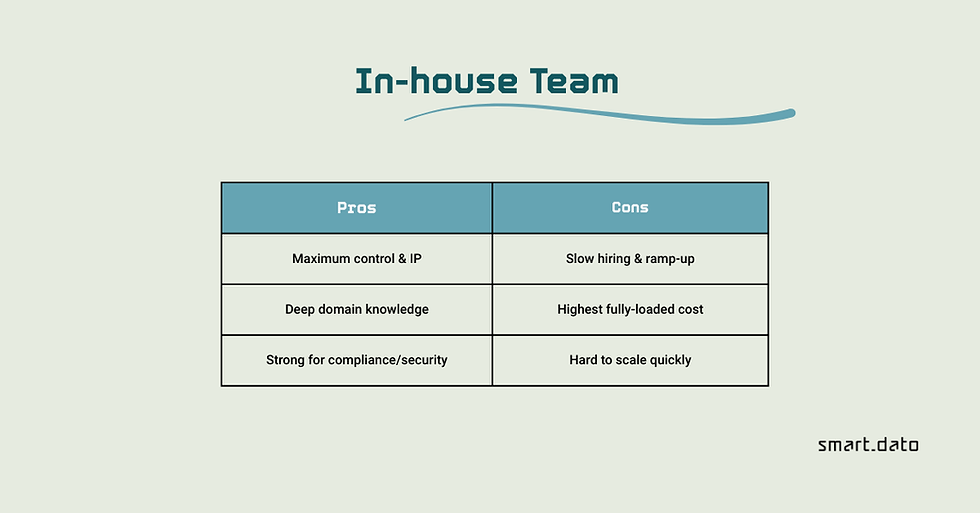
In-house | Core IP, compliance-heavy domains, long-term strategic capability building | Need results immediately, unclear roadmap, limited hiring bandwidth | Slow (hiring + onboarding + team formation) | Low–Medium (many “fully-loaded” costs beyond salary) | Very High | Medium (hiring takes time; layoffs are costly) | High (if retention and leadership are strong) |
Definitions and Key Differences for Dedicated Development Team, Agency, and In-house
What is a Dedicated Development Team and how it differs from Team Augmentation?
A dedicated development team is a stable, long-term team that works exclusively on your product or program. Instead of assigning random available engineers per project, the provider forms a consistent team that builds context over time, follows an agreed delivery process, and is accountable for outcomes. This is particularly valuable when building custom software or planning custom software development that must align with specific workflows and long-term product goals.

Typical team composition depends on your needs and maturity, but often looks like:
Tech Lead (architecture decisions, code standards, reviews, technical planning)
2–6 Developers (front-end, back-end, full-stack depending on scope)
QA (manual and automation mindset, can be part-time on the early stages)
Optional: PM or Delivery Manager (cadence, reporting, stakeholder alignment)
Optional: DevOps/Cloud (CI/CD, environments, observability, release pipeline)
The team model’s biggest advantage is code ownership and continuity. The same people make the tradeoffs, learn your domain, maintain standards, and carry knowledge across releases. That reduces rework, improves predictability, and makes long-term maintainability a real goal, especially in modern software development, where requirements and integrations change quickly and the team needs to keep the development process stable.
So how is this different from team augmentation and the classic staff augmentation or dedicated team question?
Team Augmentation usually means you include one or more external specialists into your existing team. You or the engineering leadership still own delivery management, architecture direction, quality gates, and prioritization, and often the internal project manager and project management routines remain fully on your side.
A dedicated development team is closer to an extension of your organization: it can take on a full product stream with clearer delivery accountability, with a defined project manager or delivery lead and agreed project management cadence to ship and improve custom software consistently.
When team augmentation is better than a full dedicated team:
You already have strong internal engineering leadership and just need extra capacity fast.
You need a very specific skill set short-term.
Your backlog is unstable and you want to avoid committing to a full squad until priorities settle.
In short: augmentation boosts capacity; a dedicated team builds capability and continuity for custom software that must evolve with your roadmap.
What is a Software Development Agency model?
A software development agency typically delivers work in project mode. You bring a brief, a scope, or a goal; the agency estimates effort, proposes a plan, and delivers a defined outcome, often with a heavier emphasis on packaging and delivery milestones than long-term product ownership. With an experienced software development agency, this can work well for time-boxed delivery, when the goal is new software with clearly defined outputs.
Most agencies fall into one of these types:
Project-based agency: best when scope is defined and delivery is time-bound.
Product studio: combines strategy, UX, and engineering; often helps shape the product, not just build it.
Retainer model: ongoing monthly capacity for continuous improvements, support, and incremental delivery.
In terms of commercial setup, agencies often use fixed price vs time and materials:
Fixed price is when you pay an agreed amount for a specified scope. It can work when requirements are stable and the definition is strong, and when project management is structured around fixed milestones.
T&M means you pay for the time spent. It’s more flexible when scope evolves, but needs governance to stay predictable, usually with a dedicated project manager and clear reporting.

Where agencies can become tricky is scope/change request dynamics. If your roadmap is evolving, fixed price can trigger friction: the scope must be defended, and changes become new quotes. Even in T&M, if discovery is weak, teams may burn budget on rework and re-alignment, especially on custom software development where requirements are tightly tied to internal operations.
An agency can be a great fit for short, well-scoped delivery. But for long-lived products, you’ll want to evaluate how they handle continuity and long-term maintainability.
What does In-house mean?
An in-house team means you employ the people building and maintaining your software, and you own the entire system of delivery: hiring, onboarding, culture, leadership, quality standards, and long-term technical health. This model can be powerful, especially when custom software is core to your competitive advantage—but it’s also the easiest to underestimate.
The biggest misconception is cost. Salary is only part of it. The real comparison is the fully-loaded cost, which often includes:
Hiring costs: recruiting time, agency fees, interview cycles, offer negotiation
Onboarding and ramp-up: months of lower productivity while people learn domain + codebase
Retention and turnover: compensation growth, career paths, backfills, knowledge loss
HR and operations overhead: payroll, benefits, legal, employer branding
Leadership time: engineering management, technical direction, performance coaching
Tooling and infrastructure: Jira/Confluence, GitHub/GitLab, CI/CD, testing tools, environments, monitoring
These are exactly the hidden costs of in-house software development that don’t show up in a simple salary vs outsourcing rate comparison, especially when you must deliver and maintain custom software development across teams and departments.
Hiring time matters because it directly impacts time-to-market. Even with strong recruiting, building a balanced team (right seniority mix, good collaboration, shared standards) takes time. Then you still need processes, documentation habits, and ownership boundaries. Many teams feel this most at the beginning: you might have one strong engineer, but no QA, no product ops rhythm, and no runway for experimentation while shipping new software and selecting appropriate technologies that fit your product and organization.
In-house is often the right move when you have a stable, long-term backlog and can invest in leadership and retention. But if you need predictable delivery quickly or you’re not ready to run engineering as a system - an external model may get you to results faster while you build internal capability in parallel, especially for custom software initiatives that depend on the right software developers, strong governance, and choosing appropriate technologies from the start.
When each model fits
Choosing between a dedicated development team, a software development agency, and an in-house development team is more about which one matches your reality right now: product maturity, speed expectations, internal leadership capacity, and how stable (or volatile) your roadmap is.
Below, we’ll break down the typical scenarios where each model performs best, the tradeoffs you should expect, and the common traps to avoid.
When a Dedicated Development Team is the best choice
A dedicated development team is usually the best fit when you’re building a product that will evolve month after month. If your roadmap includes continuous releases, new features based on user feedback, integrations, and ongoing optimization, you need a setup that rewards continuity and long-term thinking.
This is also when to use a development team model: when product ownership matters and you want a team that can carry context across sprints. Continuity is how you avoid slowdowns caused by repeated onboarding, fragmented code ownership, and scattered decisions. Over time, knowledge retention becomes a competitive advantage: fewer regressions, cleaner architecture decisions, and more predictable delivery.
A dedicated setup is especially strong when you need to scale delivery but don’t want the hiring burden. Instead of building a full recruiting pipeline, you can increase capacity by adding roles or adjusting the seniority mix. That’s what makes it practical for scaling development team capacity without losing momentum. You can also build remote development team capabilities faster, because governance (cadence, reporting, standards) is part of the operating model from day one.
If you want a stable product team that owns outcomes, it’s time to hire dedicated developers as a team, so delivery, quality, and long-term maintainability improve together.

When an Agency makes sense and when it doesn’t
A software development agency can be the right choice when the work is truly project-shaped: a clear scope, a fixed deadline, and a defined outcome. Common examples are an MVP with very specific requirements and a redesign with limited functionality changes. In these cases, an agency’s packaging can be efficient, especially if you need quick kickoff.
You can also work with agencies in early-stage discovery and prototyping. If you’re validating an idea, testing UX flows, or building a proof of concept, a product studio-style agency can help you move fast and reduce uncertainty. This is often why people search for the best model for MVP, the right answer depends on whether you’re optimizing for speed of validation (agency) or continuity after validation (dedicated team / in-house).
Where agencies become a weaker fit is when scope volatility is high and stakeholders discover requirements mid-build. The classic red flag is: an agency pushes fixed price for fuzzy scope. That combination almost guarantees friction, because scope control turns into change requests, and progress turns into renegotiation. If your roadmap is evolving, you’ll usually get better results with a model designed for iteration, not one optimized for fixed deliverables.

When In-house is the right move
An in-house development team is the right move when software is part of your strategic core and you want full control over execution, knowledge, and long-term capability. This is especially true if you’re building core IP, operating in compliance-heavy environments, or handling sensitive data where governance, security practices, and internal accountability are non-negotiable. In-house teams can also be ideal when the backlog is stable and long-term, because the value compounds as your team deepens domain expertise and refines internal standards.
That said, in-house works best when you have strong internal leadership available, someone who can own technical direction, delivery cadence, hiring standards, and quality practices. Without that, an in-house setup can stall: hiring slows down time-to-market, onboarding absorbs weeks of productivity, and the team struggles to build consistent habits around documentation, QA, and maintainability.
The decision also depends on your stance on outsourcing vs in-house development. If your organization has the plan to build engineering as a system, in-house pays off with control and long-term resilience. But if you need outcomes quickly and don’t yet have the management bandwidth, many companies start with external delivery while gradually building internal capability.
Cost drivers
Choosing between a dedicated development team, a software development agency, and in-house is ultimately a cost-and-risk tradeoff. The headline rate is rarely the real story. The real differentiator is the cost drivers software development team leaders actually feel: ramp-up time, rework, team stability, management overhead, and how predictable delivery is when requirements change from the moment a project begins, especially when building digital products for a specific target group across web and mobile devices, including mobile apps, and trying to capture market opportunities using agile methods.
This section breaks down the cost levers that typically determine the total cost of ownership across models. We’ll cover dedicated development team pricing models, what a dedicated team contract model really buys you, where fixed price goes wrong, and why the hidden costs of in-house software development can surprise even mature organizations over an extended period. By the end, you should be able to explain your choice not just to engineering, but to finance and leadership as well.
Pricing models: Dedicated team vs T&M vs Fixed price
These pricing models are a statement about what you want to optimize, what your project requires, and how you plan to deliver custom software and other digital products with the right mix of specialists, including full stack developers and stack developers, using modern technologies and agile methods.
Fixed price optimizes for budget certainty when scope is stable. You agree on deliverables, timeline, and price. It can work well for well-defined builds, migrations with known steps, or tightly specified features for existing applications where the project requirements are truly locked.
Time & Materials (T&M) optimizes for flexibility. You pay for actual effort, which is safer when discovery is ongoing, priorities shift, or you’re iterating based on feedback for your target group.
A dedicated team contract model typically optimizes for continuity and throughput. Instead of buying “a project,” you secure a stable capacity unit (a squad or partial squad) and adjust team size/seniority as needs change

.
In practice, dedicated development team pricing models are often structured as a monthly rate based on roles and seniority. The advantage is predictability: once the team is stable, you can forecast burn rate and tune output by adjusting capacity rather than renegotiating scope, which often leads to meaningful cost savings over an extended period.
Where fixed price fails is scope volatility. If requirements are fuzzy, stakeholders are many, or you’re integrating with unknown systems, fixed price creates incentives to protect margin: corners get cut, quality suffers, and change requests explode. In those environments, T&M or a dedicated model tends to reduce friction because the commercial model matches the reality of product work: learning and iteration.
Hidden costs
The biggest silent spend is time and disruption. With in-house, the hidden costs of in-house software development are usually not the salary line—they’re everything around it: recruiting cycles, onboarding time, retention work, and productivity dips when people leave. Every replacement means lost context, slowed delivery, and management time diverted from product progress to hiring and coaching.
External models have their own hidden costs. With a software development agency, you may pay less attention to continuity, and then pay for it later in handover gaps, inconsistent standards, or context switching between projects. With a dedicated team, the hidden costs are typically lower if the team is truly stable and governance is clear, but you still need disciplined onboarding and documentation so knowledge retention doesn’t depend on one person, especially when multiple stack developers and specialists rotate through work on the same product.
Across outsourcing vs internal, watch for:
Vendor lock-in (no exit plan, unclear ownership, hard-to-transfer knowledge)
Context switching (team members split across multiple clients → lower focus, slower iteration)
Handover risk (insufficient documentation, weak testing, missing architectural decisions)
This is where outsourcing vs in-house development becomes less about ideology and more about operating reality: can you maintain continuity and accountability over time?
Quality costs: QA, rework, maintainability, tech debt
Quality is a cost driver whether you see it or not. Poor QA creates rework, delayed releases, and the slow erosion of iteration speed. The logic is consistent: weak testing → defects escape → hotfixes and firefighting → roadmap slips → more pressure → more shortcuts → even more defects, particularly when your project requires releases across mobile devices and multiple environments, where quality assurance needs to be systematic.
No matter the model, the cost comes from:
Missing or shallow testing strategy
No clear quality gates (code review, automated tests, CI/CD checks)
Underinvested QA capacity relative to feature output
Accumulating technical debt without a plan to pay it down
Low maintainability (hard-to-change code → slow delivery)
A dedicated setup can reduce these costs when the team owns standards long-term and can invest in automation and maintainability. An agency can deliver quality too, but it requires explicit expectations and governance, not assumptions. For in-house, quality depends heavily on leadership maturity and whether engineering has the time and mandate to build sustainable practices with qa engineers, strong quality assurance, and continuous integration aligned to agile methods and the realities of modern technologies.
Cost driver checklist (use this to compare quotes):
Team stability (expected churn / shared across clients?)
Seniority mix aligned to complexity, including the right balance of full stack developers
Onboarding plan + documentation ownership
Code/IP ownership terms and repo access from day one
QA approach (manual + automation) and test coverage expectations with qa engineers
Code review policy + definition of done
CI/CD and release workflow maturity
Sprint cadence + reporting (predictability, transparency)
Handling scope changes (process + commercial alignment)
Exit plan / handover process (avoid vendor lock-in)
Security & compliance requirements (GDPR, access control)
Maintenance plan (who owns fixes after release?)
Red flags
Choosing an external partner is about whether the setup will stay healthy after week two, when priorities shift and delivery pressure increases. Most failures come from weak ownership, poor governance, and missing continuity. Treat this section as a practical checklist of dedicated team red flags / warning signs and software agency red flags, plus simple ways to verify what you’re being promised.
Dedicated team red flags
A dedicated development team should feel like an extension of your organization: stable, accountable, and transparent. Watch out for:
“Dedicated” but shared resources: the same people are quietly split across clients. This kills focus and predictability.
High churn or unclear team stability: frequent replacements break knowledge transfer and continuity.
Blurry ownership: no clear Tech Lead, unclear who decides architecture, unclear who owns quality.
Weak governance: no regular sprint cadence, inconsistent reporting, no measurable delivery rhythm.
Documentation as an afterthought: important decisions are not captured; onboarding new members is painful.
Vendor lock-in by design: access to repos, environments, or deployment pipelines is restricted or delayed.
Agency red flags
A software development agency can deliver great outcomes—if alignment is strong and transparency is real. Be cautious if you see:
Fixed price pushed on fuzzy scope: it often turns into change-request battles and shortcuts.
Vague estimates : no visibility into progress until the end of a phase.
Weak discovery: rushing into build without clarifying assumptions and constraints.
No clear quality practices: little mention of code review, test strategy, or QA ownership.
Handover risk: delivery ends without a transition plan, documentation, or maintainability approach.
How to reduce risk
Use these questions to reduce risk early:
Ask for a sample sprint report (what does “transparent delivery” look like in practice?).
Ask who owns repos/IP from day one (repo access, admin rights, IP clauses, NDA terms).
Ask how they do code review + QA (definition of done, QA responsibilities, test strategy, CI/CD checks).
Ask about the exit / transition plan (handover documentation, knowledge transfer sessions, timelines, and what’s included).
Ask how they handle scope changes (process + commercial alignment).
Ask what happens if a key person leaves (continuity plan, onboarding process, documentation standards).
If a vendor can’t show artifacts, such as reports, templates, examples of documentation, it’s a signal that the process may depend on heroics, not a reliable system, and you may lose the competitive edge you’re trying to build.
Decision framework
The fastest way to make a confident choice is to score your situation against a few criteria. This section answers how to choose a dedicated development team in a correct way.
Step 1: Score your needs
Use 0–3 where 0 = low importance / low need, 3 = very important / very high need.
Criteria (0–3) | What “3” looks like | Model that usually fits best |
1) Speed to start (ramp-up) | You need delivery moving in weeks, not months | Agency or Dedicated Team |
2) Scope volatility | Requirements will change as you learn | Dedicated Team or T&M agency |
3) Need for continuity & knowledge retention | Same team must carry context long-term | Dedicated Team or In-house |
4) Product ownership & roadmap responsibility | You want strong delivery accountability + roadmap support | Dedicated Team or In-house |
5) Internal management capacity (governance) | You have limited bandwidth to manage daily execution | Dedicated Team (with governance) or Agency |
6) Control & IP ownership requirements | Core IP, strict access control, high sensitivity | In-house (or Dedicated with strong terms) |
7) Compliance & security pressure (GDPR, audits) | Formal processes, security requirements, documentation | In-house or Dedicated (mature processes) |
8) Scaling flexibility | You may need to scale up/down without hiring cycles | Dedicated Team or Agency |
Step 2: Interpret your score
You can use these rules of thumb:
If continuity + roadmap ownership scores highest (criteria 3–4) and you want scaling flexibility (8): a dedicated development team is often the sweet spot, especially for ongoing product work.
If speed to start is critical (1), scope is clear (2 is low), and you have a deadline: an agency can be efficient—just align scope control and quality gates.
If IP/control + compliance are the top drivers (6–7) and you have leadership capacity: build or grow an in-house development team for long-term strategic advantage.
Step 3: Add governance requirements
Whatever you choose, define governance up front:
sprint cadence and reporting
who approves scope changes
code review and QA expectations
documentation ownership
exit strategy (handover plan)
This is how you turn a model into a reliable operating system, not a hope.
Common mistake patterns
MVP + no product owner + fixed price = pain. Without product ownership and clear decision-making, scope expands and delivery becomes a negotiation.
Hiring in-house without leadership bandwidth. Great developers still need direction, standards, and quality gates.
Choosing an agency for a long-term roadmap without continuity guarantees. Handover gaps and context switching erode maintainability.
Choosing a dedicated setup without verifying stability. If people rotate, you’re paying for onboarding repeatedly.
Optimizing for rate, not for total cost. Rework, slow ramp-up, and weak QA can dwarf any savings.
Build your dedicated team with Smart Dato
Since 2015, we’ve been helping companies across Italy and the DACH region deliver custom software development, mobile app development, and e-commerce solutions, including Shopware and Shopify, plus integrations via Smart Dato Hub.
We work with teams in manufacturing, logistics, retail/e-commerce, and service-driven businesses, delivering scalable digital products such as B2B/B2C platforms, internal process automation, and data-driven applications with strong project management and quality assurance.
Smart Dato focuses on continuity and delivery discipline: clear onboarding, transparent reporting, and a structured development process with strong project management and quality gates (code review, quality assurance, and CI/CD practices where relevant).
Whether you need to scale quickly, modernize existing applications, or build new digital products from scratch, we assemble a team that’s aligned not only on technical skills but also on communication, collaboration, and ownership.
FAQ
What is a dedicated development team?
A dedicated development team is a stable team (often tech lead, developers, QA, and optional PM/DevOps) that works continuously on your product. The key benefit is continuity: the same team owns the codebase, builds domain knowledge, and delivers predictable iterations over an evolving roadmap and long-term maintenance.
Dedicated team vs staff augmentation: what’s the difference?
Augmentation adds individual specialists to your existing team, so you keep delivery ownership and management. A dedicated team is a team with a stable operating rhythm and clearer accountability for outcomes.
Is a dedicated team cheaper than in-house?
It can be, depending on what you include. In-house costs include hiring time, onboarding, retention, leadership overhead, and tooling. A dedicated team often improves cost predictability and avoids long ramp-up, while in-house can be the best long-term investment if you can sustain leadership and retention.
What are red flags when choosing an outsourcing partner?
Key red flags: vague estimates, weak discovery, no clear code review/QA process, limited transparency, and unclear repo/IP ownership or exit plan. These issues often lead to rework and vendor lock-in. Ask for sample sprint reports and documentation examples before you commit.
Which model is best for long-term product development?
For long-term product work, continuity matters most. A dedicated team or strong in-house team usually wins because knowledge retention and code ownership stay consistent across releases.
What is a best model for MVP: agency vs dedicated vs in-house?
The best model for MVP depends on your goal. For fast validation with clear scope and deadline, an agency can be efficient. If you expect rapid iteration after launch, a dedicated team is often better. In-house is strongest when software is core and you have leadership ready, but it’s slower to ramp up.
To sum up
There’s no single best model, only the one that fits your product stage, how much your roadmap will change, and how much internal time you can devote to managing delivery. If you’re building a product that will keep evolving, a dedicated development team is often the most practical middle ground.
Agencies can be great for tightly scoped delivery or early discovery, but they can struggle when priorities shift and scope becomes fluid. In-house can be the strongest long-term investment when software is your strategic core and you can commit to leadership and hiring.
If your goal is to move fast while keeping control and long-term maintainability, it may be time to hire dedicated developers as a stable squad rather than piecing together short-term capacity.

Comments