Custom Enterprise Software for SMEs: A Practical Checklist

For many small and medium-sized enterprises, enterprise software still sounds like something reserved for global corporations with massive IT budgets and in-house teams. Yet in reality, more and more mid-market companies depend on enterprise-grade software every day, even if they don’t label it that way.
If your business handles sensitive data, integrates multiple systems, supports multiple user roles, or must comply with regulations like GDPR, you already face enterprise-level requirements.
The real question is not whether SMEs need enterprise software, but how to build enterprise-ready systems without enterprise complexity.
This article explains what enterprise-grade custom software for SMEs really means, which requirements matter most, and how to evaluate whether your current systems are truly fit for long-term growth.
This guide is written for SME founders, business leaders, and IT decision-makers who need enterprise-level reliability, security, and integrations without enterprise-level complexity.

Enterprise Software Explained for SMEs
Enterprise software refers to systems designed to support complex, mission-critical operations across organizations, including security, integrations, governance, and long-term scalability.
It's often misunderstood as something reserved for large corporations with thousands of employees and global IT departments. In reality, enterprise software solutions are not defined by company size, but by capabilities. They are shaped by the complexity of business processes, data sensitivity, integration needs, and long-term operational requirements, such as challenges that increasingly affect small and medium-sized enterprises as well.

Common types of enterprise software include:
ERP (Enterprise Resource Planning): centralizes finance, operations, and supply chain processes
CRM (Customer Relationship Management): manages customer data, interactions, and sales pipelines
SCM (Supply Chain Management): coordinates logistics, inventory, and supplier workflows
BI (Business Intelligence): analyzes and visualizes data for reporting and decision-making
EAM (Enterprise Asset Management): tracks and maintains physical assets across their lifecycle
Project Management Software: plans and tracks cross-department initiatives
Core Systems: Enterprise Resource Planning and Customer Relationship Management
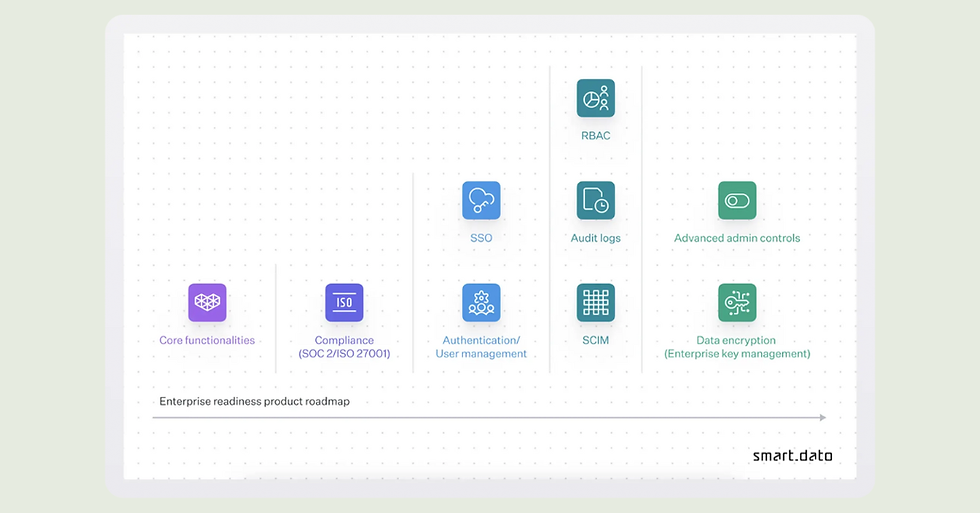
At its core, enterprise software is designed to support mission-critical business operations in a reliable, secure, and scalable way. Typical characteristics include advanced security and access control, structured role-based access control and permissions, audit logs for traceability, high availability with uptime guarantees, and deep integrations with existing systems such as enterprise resource planning (ERP), customer relationship management (CRM), PIM, or WMS — all operating within a broader enterprise application software landscape.
Enterprise resource planning software helps organizations manage multiple business processes from a centralized system, including finance, operations, and supply chain activities.Just as important are aspects like data ownership, governance, observability, monitoring, and long-term maintainability, which are now considered baseline expectations of modern enterprise application software.
Business intelligence software brings together data from multiple sources to support analysis and reporting, providing decision-makers with a consistent view of performance through interactive dashboards. For SMEs, embedded BI capabilities make it possible to monitor operations, identify risks early, and support data-driven decisions without relying on external tools.
For a long time, these capabilities were associated almost exclusively with large enterprises. Today, that distinction no longer holds.

Why Enterprise Requirements Are No Longer Enterprise-Only
Many SMEs now operate in environments that are just as complex as those of larger organizations. Regulatory pressure, data protection requirements such as GDPR, growing integration landscapes, and higher expectations from existing customers and partners have raised the bar significantly, especially for business processes and day-to-day business operations.
Even a mid-sized company may need:
Fine-grained permissions across multiple departments
Secure access for external partners or suppliers
Full audit trails for compliance or internal controls
Reliable system availability for business-critical workflows
Clear rules around data retention and data ownership ( in inventory management, supply chain management, or enterprise asset management contexts)
Supply chain management software is designed to optimize and manage end-to-end processes across the supply chain, including inventory management, logistics coordination, and demand forecasting.
At the same time, SMEs typically have fewer internal IT resources, leaner teams, and much lower tolerance for vendor lock-in or excessive complexity. This creates a unique tension: enterprise-level needs without enterprise-level budgets or overhead.
The SME Reality: Enterprise Requirements Without Enterprise Budgets
Mid-market companies operate in a space that is often overlooked by traditional software vendors.
On one side, standard SaaS tools are usually designed for simplicity and mass adoption. They work well for generic use cases, including project management software, which helps teams plan, manage, and track the progress of projects across different departments, but quickly reach their limits when business processes become more specific, when integrations grow, or when governance and security requirements increase, especially when compared to full enterprise application software.
On the other side, large enterprise platforms are built to cover every possible scenario. While powerful, they often come with heavy configuration layers, rigid workflows, and licensing models that scale aggressively with users or modules, which is a poor fit for many SMEs.
As a result, SMEs often find themselves in one of these situations:
The software covers most needs but forces constant workarounds across core business processes
Critical business logic lives outside the system in spreadsheets or manual steps
Integrations become brittle or impossible to extend
Compliance requirements are only partially met — a common limitation of standard enterprise platforms in SME realities
Typical SME scenarios that trigger enterprise-level needs include:
Multiple departments requiring different access rights and responsibilities
External users (partners, distributors, customers) accessing internal systems
Integration-heavy system landscapes with ERP, customer relationship management, logistics, and data analytics tools — often supporting supply chain management and inventory management
Long data retention periods driven by regulation or contractual obligations
Processes that directly affect revenue, delivery, or compliance and simply cannot fail
In these cases, enterprise software development must strike a careful balance. Systems need to be robust and secure, but also maintainable, and economically viable. This is why modern enterprise software solutions increasingly blend traditional enterprise principles with flexible enterprise application software approaches that fit the realities of mid-market organizations.
Why Standard Enterprise Platforms Don’t Work Well for SMEs
Large enterprise platforms promise that everything will be in one system. For SMEs, this promise often turns into a liability. Common challenges include:
Overloaded feature sets that add complexity without real value
Rigid workflows that force teams to adapt their processes to the tool instead of the other way around
Expensive licensing models, often priced per user or per module
Limited integration flexibility, especially when connecting non-standard systems
Vendor lock-in, making long-term changes slow and costly
A common pattern is that around 70–80% of requirements are covered reasonably well, but the remaining 20–30% are exactly where the company’s competitive advantage lies. That last portion often includes pricing logic, approval flows, data synchronization rules, or customer-specific processes.
When those critical parts cannot be implemented cleanly, productivity drops, errors increase, and teams start building parallel processes outside the system. Over time, this undermines both efficiency and data quality.
This is where secure custom software development becomes a strategic alternative. Instead of adapting the business to the software, custom enterprise software allows SMEs to design systems around their real processes, while still meeting enterprise-level standards for security, compliance, and scalability.
What Makes Software Truly Enterprise-Ready
Being enterprise-ready means that a system can reliably support day-to-day operations, scale with growing complexity, and protect the business in a competitive market. Below is a practical checklist that helps small and mid-market companies assess whether their software truly meets enterprise standards.

1. Security by Design
Security is foundational, not optional.
Enterprise software solutions are designed with security embedded from the very beginning. This includes privacy by design and secure by design development principles, a clear separation of data domains, and encryption both at rest and in transit. Controlled access to sensitive operations ensures that individual users can only perform actions relevant to their role.
For SMEs, security is not about achieving theoretical perfection. It is about risk control, predictability, and protecting business operations, customer data, and intellectual property. When security is bolted on later, costs rise and vulnerabilities multiply.
2. Role-Based Access Control for Customer Relationship Management and Core Systems
Role-based access control is one of the clearest indicators of enterprise maturity.
A structured RBAC model allows companies to define roles based on responsibilities, control data visibility, and reduce human error across different departments. This is especially important when systems support internal teams, partners, or customers at the same time.
RBAC is a core requirement in enterprise application software and is closely tied to systems like customer relationship management, where sales, support, and finance teams require different levels of access to customer data, sales pipelines, and reporting.
3. Audit Logs and Audit Trails
Audit logs and audit trails answer critical questions: who changed what, when it happened, and what the previous state was. These capabilities are essential for regulatory compliance (including GDPR), internal accountability, and incident investigation.
Beyond compliance, audit trails support business intelligence by providing historical data for analysis, process optimization, and root-cause investigations. Many SMEs only realize the importance of auditability after their first serious incident — but by then, retrofitting it is expensive and risky.
4. Identity Management: SSO & SCIM
Enterprise systems rarely exist in isolation.
Modern enterprise-grade custom software supports Single Sign-On, identity federation, SCIM-based user provisioning, and centralized access revocation. This improves both security and user experience, especially in environments where enterprise resource planning, project management software, and other tools are used together.
Centralized identity management reduces onboarding friction, simplifies offboarding, and minimizes security gaps when people change roles or leave the company.
5. GDPR, Data Privacy and Data Retention
Key considerations include clear data ownership, purpose limitation, structured data retention policies, right-to-access and right-to-delete workflows, and a clean separation between operational and analytical data. This is particularly important in systems supporting supply chain, inventory management, and customer-facing processes.
Custom enterprise software allows SMEs to implement exactly the compliance logic they need, without inheriting unnecessary constraints from generic platforms.
6. Observability, Monitoring and Business Intelligence
If you cannot observe your system, you cannot operate it safely.
Enterprise-ready platforms include structured logging, application monitoring, error tracking, performance metrics, and defined incident response workflows. Together, these form the backbone for operational reliability.
Observability also enables real time analytics and business intelligence, giving decision-makers access to interactive dashboards that reflect the actual state of the system. For SMEs, this visibility is critical to respond quickly to issues, optimize processes, and maintain trust with customers and partners.
By consolidating operational data, enterprise software improves reporting quality and enables faster, more informed decision-making across the organization. Access to real-time insights supports proactive management rather than reactive problem-solving.
7. CI/CD and Release Management
A mature delivery setup includes CI/CD pipelines, automated testing, controlled release management, rollback strategies, and environment separation (development, staging, production). These practices reduce downtime, prevent regressions, and allow teams to innovate safely.
For SMEs, this discipline directly impacts cost savings, productivity, and ROI, especially when software underpins revenue-critical workflows.
8. Modular Architecture and Maintainability
Enterprise-grade custom software is modular by design, clearly layered, and technically documented to reduce technical debt. This ensures easier onboarding of new developers, lower long-term maintenance costs, and safer feature expansion.
In practice, maintainability often matters more than raw scalability, especially for SMEs that must adapt quickly as business processes evolve.
9. API Integrations & System Landscape (ERP, CRM, Supply Chain)
Most SMEs operate a system landscape, not a single application.
Enterprise software must integrate seamlessly with enterprise resource planning, customer relationship management, enterprise asset management, logistics systems, and external data providers across the supply chain. CRM software consolidates customer information in a single database, helping organizations manage interactions, sales pipelines, and long-term customer relationships more effectively. A strong integration backbone ensures data consistency, clear system-of-record ownership, reduced manual work, and future extensibility.
These integrations also enable better business intelligence by consolidating data across systems.
10. SLA, Support Model and Uptime
Defined SLA levels, clear support responsibilities, monitoring-abacked uptime guarantees, and predictable response times are essential. Custom enterprise software allows SMEs to align support models with real business impact — not generic service tiers.
In summary, implementing enterprise-grade custom software can improve operational efficiency, enhance collaboration across departments, strengthen compliance and risk management, and unlock data-driven decision-making while acknowledging the challenges of cost, complexity, and change management. For SMEs, the key is not to copy large enterprises, but to adopt enterprise principles in a pragmatic, scalable way.
Ready to build enterprise software without enterprise complexity?
If you need secure integrations, auditability, monitoring, and long-term maintainability, let’s discuss your requirements and timeline.
Custom Enterprise Software vs Standard Enterprise Platforms
Aspect | Standard Enterprise Software | Custom Enterprise Software |
Flexibility | Limited | High |
Cost model | License-based | Project-based |
Integration | Often constrained | Designed to fit |
Security | Generic | Context-aware |
Scalability | Horizontal | Business-driven |
Ownership | Vendor | Company |
For many SMEs, enterprise software development services deliver better ROI when tailored to actual workflows.
Where Smart Dato Fits In
Smart Dato specializes in enterprise-grade custom software development for SMEs and mid-market companies that operate in complex, integration-heavy environments. Many of these organizations face enterprise-level requirements in their daily operations, but without the internal structures, budgets, or teams typically found in large corporations.
We build enterprise-ready software solutions that remain transparent, maintainable, and economically viable. The emphasis is on real business operations: secure access, clear responsibilities, reliable integrations, and systems that can evolve safely over time.
Security by design and a GDPR-oriented architecture are core principles. Robust RBAC models ensure controlled access across accounting, sales, logistics, and reporting workflows, while modular system design keeps long-term maintenance predictable. Integration expertise via the Smart Dato Hub connects ERP, CRM, and other core platforms into a coherent, auditable system landscape, backed by clear support models and defined SLAs.
Case Study: Polyfaser
A practical example of this approach is our client, Polyfaser, a mid-market manufacturing company with complex products and long sales cycles.Polyfaser relied on fragmented tools for sales, product data, and offer creation. This led to slow processes, manual workarounds, and a growing risk of configuration errors as product complexity increased.
We developed a custom CRM platform tailored to Polyfaser’s workflows, with a centralized product data model, structured pricing logic, automated notifications, and operational dashboards. The system was fully integrated with the existing ERP to ensure consistent data across departments.
As a result, faster and more reliable offer creation, fewer configuration errors, simpler onboarding for new users, and a scalable foundation that supports future growth
Common SME Use Cases for Enterprise-Grade Software
Enterprise requirements often emerge naturally in SMEs, regardless of company size or number of employees. Common use cases include:
Internal process platforms that unify operations across departments
B2B customer portals with role-based access and secure data sharing
Logistics and supply chain systems handling complex workflows
Sales automation and pricing engines connected to accounting and reporting
Compliance-heavy data platforms serving regulated industries
SaaS products designed for organizations operating within strict industry standards
In each case, enterprise-grade software solutions help organizations maintain control, reduce risk, and scale confidently.
Final Checklist: Is Your Software Enterprise-Ready?
Ask yourself:
Can we control access at a role level across different teams?
Can we trace critical actions and changes for reporting or audits?
Do we clearly understand who owns our data?
Are integrations reliable, documented, and future-proof?
Can the system evolve safely over the next 3–5 years?
Do we understand the operational risks within our current setup?
If several of these questions remain unanswered, it may be time to consider enterprise-grade custom software.
To Sum Up
For SMEs, enterprise software is about resilience, control, and scalability in a competitive market. By focusing on security, integrations, maintainability, and operational transparency, custom enterprise software enables organizations to compete confidently across their industry.
Smart Dato helps organizations build software that supports their operations today, adapts to future requirements, and delivers real, measurable value across a broad range of business challenges.


Can I add a few quick thoughts here? Most enterprise software completely ignores small businesses because developers love overcomplicating things for fat corporate budgets. Is there a simple way to integrate these modular systems without hiring a whole new IT department? We run a regional delivery fleet in southern Germany and we almost went crazy trying to manage asset lifecycles until I checked out https://smartmakers.io/en/tracking-losung-von-smartmakers-optimiert-flottenmanagement-bei-emil-egger/ which totally changed our approach to fleet logistics. The real turnaround was seeing exactly how they optimized their heavy transport operations. We applied that exact tracking logic and saved about 15% on fuel and route idling within the first month. What do you think is the biggest mistake SMEs make during their initial software rollout?